Showing posts with label Reformed Theology. Show all posts

Wednesday, July 29, 2009

Perseverance of the Saints...in John 3:16?


Spurgeon thinks so. I see it now, too.

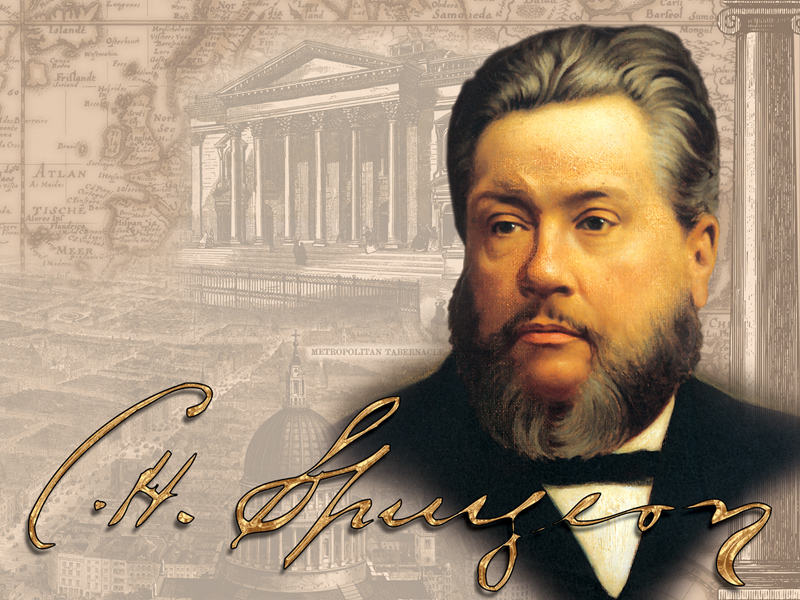
In a sermon titled "Immeasurable Love", which C. H. Spurgeon preached July 26th, 1885 at the Metropolitan Tabernacle, a sermon based entirely on John 3:16, he said:
[Whosoever believeth], his faith shall not perish, for this promise covers it - "Whosoever believeth in Him shall not perish." The penitent has believed in Jesus, and therefore he has begun to be a Christian; "Oh," cries an enemy, "let him alone: he will soon be back among us; he will soon be as careless as ever." Listen. "Whosoever believeth in Him shall not perish," and therefore he will not return to his former state. This proves the final perseverance of the saints; for if the believer ceased to be a believer he would perish; and as he cannot perish, it is clear that he will continue as a believer. If thou believest in Jesus, thou shalt never leave off believing in him; for that would be to perish. If thou believest in him, thou shalt never delight in thine old sins; for that would be to perish. If thou believest in him, thou shalt never lose spiritual life. How canst thou lose that which is everlasting? If thou wert to lose it, it would prove that it was not everlasting, and thou wouldst perish; and thus thou wouldst make this word to be of no effect. Whosever with his heart believeth in Christ is a saved man, not for to-night only, but for all the nights that ever shall be, and for that dread night of death, and for that solemn eternity which draws so near. "Whosoever believeth in Him shall not perish;" but he shall have a life that cannot die, a justification that cannot be disputed, an acceptance which shall never cease.

Monday, July 20, 2009

The Reformed Resurgence


Collin Hansen has an ongoing series over at The Resurgence, titled The Reformed Resurgence, in which he briefly chronicles the major players in the comeback of reformed/calvinistic theology in the American Evangelical church. I have benefited greatly from each of the pastors and ministries Hansen mentions thus far, and I consider myself and our church a part of this resurgence. If you want to know more, consider continuing with this series, and also consider ordering Hansen's book, titled Young, Restless, Reformed: A Journalist's Journey with the New Calvinists. Hansen's book and other work has also been helpful to me on this journey.

Blogposts in Hansen's series thus far:

Beginnings
John Piper and Bethlehem Baptist Church
Al Mohler and Southern Seminary
C. J. Mahaney and Sovereign Grace

[I'll add to this list once the series is completed.]

Saturday, October 25, 2008

Why I Don't Do Altar Calls

Dr. Martyn Lloyd-Jones answers quite effectively (courtesy of Banner of Truth):

Early in the 1970s Dr Martyn Lloyd-Jones was the speaker at a ministers' conference in the USA and at a question session was asked the following question:

Q: During recent years, especially in England, among evangelicals of the Reformed faith, there has been a rising criticism of the invitation system as used by Billy Graham and others. Does Scripture justify the use of such public invitations or not?

A: Well, it is difficult to answer this in a brief compass without being misunderstood. Let me answer it like this: The history of this invitation system is one with which you people ought to be more familiar than anyone else, because it began in America. It began in the 1820s; the real originator of it was Charles G. Finney. It led to a great controversy. Asahel Nettleton, a great Calvinist and successful evangelist, never issued an "altar call" nor asked people to come to the "anxious seat." These new methods in the 182Os and were condemned for many reasons by all who took the Reformed position.

One reason is that there is no evidence that this was done in New Testament times, because then they trusted to the power of the Spirit. Peter preaching on the Day of Pentecost under the power of the Spirit, for instance, had no need to call people forward in decision because, as you remember, the people were so moved and affected by the power of the Word and Spirit that they actually interrupted the preacher, crying out, "Men and brethren, what shall we do?" That has been the traditional Reformed attitude towards this particular matter. The moment you begin to introduce this other element, you are bringing a psychological element. The invitation should be in the message. We believe the Spirit applies the message, so we trust in the power of the Spirit. I personally agree with what has been said in the question. I have never called people forward at the end for this reason; there is a grave danger of people coming forward before they are ready to come forward. We do believe in the work of the Spirit, that He convicts and converts, and He will do His work. There is a danger in bringing people to a "birth," as it were, before they are ready for it.

The Puritans in particular were afraid of what they would call "a temporary faith" or "a false profession." There was a great Puritan, Thomas Shepard, who published a famous series of sermons on The Ten Virgins. The great point of that book was to deal with this problem of a false profession. The foolish virgins thought they were all right. This is a very great danger.

I can sum it up by putting it like this: I feel that this pressure which is put upon people to come forward in decision ultimately is due to a lack of faith in the work and operation of the Holy Spirit. We are to preach the Word, and if we do it properly, there will be a call to a decision that comes in the message, and then we leave it to the Spirit to act upon people. And of course He does. Some may come immediately at the close of the service to see the minister. I think there should always be an indication that the minister will be glad to see anybody who wants to put questions to him or wants further help. But that is a very different thing from putting pressure upon people to come forward. I feel it is wrong to put pressure directly on the will. The order in Scripture seems to be this - the truth is presented to the mind, which moves the heart, and that in turn moves the will.

Wednesday, July 30, 2008

J.I. Packer: The four theological issues I (PG) should study in order to be prepared for the next fifty years...


In the lengthy time that Dr. J. I. Packer afforded me to speak with him while we were recently together in Orlando, I asked him which theological issues he would commend young Christian leaders to study in order to be prepared for the next fifty years. His list was quite insightful:

1. Regeneration — He said that the doctrine of regeneration has not been fully appreciated by many who do not understand that to be born again with a new heart and new nature means that we have at our deepest level a new identity and new passionate desires for God’s Word and ways. He commended to all young Christian leaders a thorough study on the doctrine of regeneration.

2. God-Centered Theology — He said that theology today is rife with man-centered thinking so that the glory of God in all things is not the essence of what is taught to be faithfully Christian. The result, he explained, is that even Christians often live their lives for the supreme purpose of their perceived happiness, feelings, and satisfaction. Yet, biblical Christianity differs from the other religions of the world in that the desires and purposes of God override ours; we are not the number one priority, but rather God is.

3. Godliness Begins at Home — This point was both surprising and refreshing. I was expecting only weighty and complicated theological admonition from such a theological giant. However, his wise counsel on this point is well needed. Packer said that most Christians do not take seriously the biblical teaching that true Christian living begins first at home with one’s spouse, children, and grandchildren. Therefore, he implored young Christian leaders to begin their quest for maturity and holiness at home in relationship with their family.

4. Trinity — Packer stated that the fullness of the doctrine of the Trinity is not completely appreciated as it should be. The result, he said, is that some Christians have only a deep understanding of Jesus or the Holy Spirit so that they are guilty of what he called “Jesus-olatry” or “Holy Spirit-olatry” rather than a full love and worshipful appreciation of God the Father, God the Son, and God the Spirit.

Thursday, July 17, 2008

TRULY Reformed...

I stumbled across this blogpost by Ray Ortlund, courtesy of Justin Taylor (this is the entirety of the post by Ortlund)...[all emphases mine]:
I believe in the sovereignty of God, the Five Points of Calvinism, the Solas of the Reformation, I believe that grace precedes faith in regeneration. Theologically, I am Reformed. Sociologically, I am simply a Christian – or at least I want to be. The tricky thing about our hearts is that they can turn even a good thing into an engine of oppression. It happens when our theological distinctives make us aloof from other Christians. That’s when, functionally, we relocate ourselves outside the gospel and inside Galatianism.

The Judaizers in Galatia did not see their distinctive – the rite of circumcision – as problematic. They could claim biblical authority for it in Genesis 17 and the Abrahamic covenant. But their distinctive functioned as an addition to the all-sufficiency of Jesus himself. Today the flash point is not circumcision. It can be Reformed theology. But no matter how well argued our position is biblically, if it functions in our hearts as an addition to Jesus, it ends up as a form of legalistic divisiveness.

Paul answered the theological aspects of the Galatian error with solid theology. But the “whiff test” that something was wrong in those Galatian churches was more subtle than theology alone. The problem was also sociological. “They make much of you, but for no good purpose. They want to shut you out, that you may make much of them” (Galatians 4:17). In other words, “The legalists want to ‘disciple’ you. But really, they’re manipulating you. By emphasizing their distinctive, they want you to feel excluded so that you will conform to them.” It’s like chapter two of Tom Sawyer. Remember how Tom got the other boys to whitewash the fence for him? Mark Twain explained: “In order to make a man or boy covet a thing, it is only necessary to make the thing difficult to attain.” Paul saw it happening in Galatia. But the gospel makes full inclusion in the church easy to attain. It re-sets everyone’s status in terms of God’s grace alone. God’s grace in Christ crucified, and nothing more. He alone makes us kosher. He himself.

The Judaizers would probably have answered at this point, “We love Jesus too. But how can you be a first-rate believer, really set apart to God, without circumcision, so plainly commanded right here in the Bible? This isn’t an add-on. It’s the full-meal deal. God says so.”

Their misuse of the Bible showed up in social dysfunction. “It is those who want to make a good showing in the flesh who would force you to be circumcised. . . . They desire to have you circumcised that they may boast in your flesh” (Galatians 6:12-13). In other words, “When Christians, whatever the label or badge or shibboleth, start pressuring you to come into line with their distinctive, you know something’s wrong. They want to enhance their own significance by your conformity to them: ‘See? We’re better. We’re superior. People are moving our way. They are becoming like us. We’re the buzz.’” What is this, but deep emotional emptiness medicating itself by relational manipulation? This is not about Christ. This is about Self. Even Peter fell into this hypocrisy (Galatians 2:11-14). But no matter who is involved, this is not the ministry of the gospel. Even if a biblical argument can be made for a certain position, and we all want to be biblical, the proof of what’s really happening is not in the theological argumentation but in the sociological integration.

Paul had thought it through. He made a decision that the bedrock of his emotional okayness would forever lie here: “Far be it from me to boast [establish my personal significance] except in the cross of our Lord Jesus Christ. . . . For neither circumcision counts for anything, nor uncircumcision, but a new creation” (Galatians 6:14-15). In other words, “Here is all I need for my deepest sense of myself: Jesus Christ crucified. His cross has deconstructed me and remade me, and I am happy. Everything else is at best secondary, possibly irrelevant, even counterproductive. Let Jesus alone stand forth in my theology, in my emotional well-being and in my relationships with other Christians!” This settledness in Paul’s heart made him a life-giving man for other people. He was a free man, setting others free (Galatians 5:1). This is the acid test of a truly Reformed ministry – that other believers need not be Reformed in order to be respected and included in our hearts.

Whatever divides us emotionally from other Bible-believing, Christ-honoring Christians is a “plus” we’re adding to the gospel. It is the Galatian impulse of self-exaltation. It can even become a club with which we bash other Christians, at least in our thoughts, to punish, to exclude and to force into line with us.

What unifies the church is the gospel. What defines the gospel is the Bible. What interprets the Bible correctly is a hermeneutic centered on Jesus Christ crucified, the all-sufficient Savior of sinners, who gives himself away on terms of radical grace to all alike. What proves that that gospel hermeneutic has captured our hearts is that we are not looking down on other believers but lifting them up, not seeing ourselves as better but grateful for their contribution to the cause, not standing aloof but embracing them freely, not wishing they would become like us but serving them in love (Galatians 5:13).

My Reformed friend, can you move among other Christian groups and really enjoy them? Do you admire them? Even if you disagree with them in some ways, do you learn from them? What is the emotional tilt of your heart – toward them or away from them? If your Reformed theology has morphed functionally into Galatian sociology, the remedy is not to abandon your Reformed theology. The remedy is to take your Reformed theology to a deeper level. Let it reduce you to Jesus only. Let it humble you. Let this gracious doctrine make you a fun person to be around. The proof that we are Reformed will be all the wonderful Christians we discover around us who are not Reformed. Amazing people. Heroic people. Blood-bought people. People with whom we are eternally one – in Christ alone.